what to do during a writing conference with elementary students
A writing conference, like whatever type of one-on-ane educational activity, can be truly powerful.
It gives us an opportunity to pause and actually notice what a child is doing. Nosotros see where they are with their writing. We better understand how they feel nearly writing.
And it also gives us a chance to provide but-right pedagogy. Because we all know that what we teach in whole grouping or fifty-fifty small group just can't attain all of our students every single day.
I've always valued one-on-one writing conferences. Just actually making them happen has been a challenge for me.
Before I became a literacy specialist, I taught grades Pre-M through 2d. And I spent most of that time teaching Kindergarten. I struggled with questions like these:
- How many students should I confer with each day?
- How often should I meet with my struggling writers?
- What should happen during a briefing?
- How volition I know what to teach during a briefing?
- How do I go my kids to work independently so that I tin stop putting out fires and actually have time to confer?
In this post, I'll share my own answers to all of these questions, besides as what I've learned from some outstanding professional development books (see my references section for some good reads). My answers may non provide perfect solutions for yous, only I promise that they will at least become you thinking about what might work in your own classroom.

Photo Credit: Monkey Business Images, Shutterstock
How many students should I confer with each day?
You lot should confer with all of your students every unmarried 24-hour interval.
…….Only KIDDING! 🙂
Unless yous have about 5 kids in your course, yous will make yourself crazy if you try to meet with all of your students every solar day! I know that I couldn't possibly take meaningful conversations if I tried to meet with every child just for the sake of doing so.
Instead, I select just a few students to confer with each day.
I do try to accept a "impact point" with nigh students throughout the day's workshop – only that tin be by calling on them during a minilesson, grin and making middle contact during independent writing fourth dimension, "calling them out" for skilful behavior/skillful writing, flashing a quick "thumbs up," having them share with the course during sharing time, and and then on.
I want every kid to feel "noticed" – but that doesn't have to be through a writing conference.
But back to the original question – how many students should we confer with each day? I wish I could give you a solid number, but that answer is "information technology depends."
It depends on:
- How long your independent writing time is each day
- How many small groups you're coming together with that day
- Where you lot are in the schoolhouse year
- If yous are launching a unit, in the middle of a unit, or finishing up a unit
A "typical" conference usually lasts 4-5 minutes for me. (Utilize a timer! This has really helped me stay on track during conferences!)
If your independent writing time is virtually 25 minutes long, and then you might get through iv, maybe 5 students each twenty-four hour period.
But and so there'south the consideration of small groups. Although I love individual writing conferences, small group instruction can be a more efficient style of meeting students' needs (more on small-scale groups in next week'southward web log mail service). And so you might have fewer private conferences because you spend some of your time educational activity a small group.
You also take to think about where yous are in your school year. At the beginning of the school twelvemonth (especially in Kinder), I get through very few writing conferences each solar day. For the first couple of weeks, I don't do writing conferences at all. And subsequently a long holiday suspension, I calibration back the number of conferences I conduct then that I can become kids re-settled in their routines.
Final, the number of conferences yous'll acquit will also depend upon where you lot are in a particular unit of measurement. If y'all usemy writing units, then y'all know that I similar to requite kids more guidance in getting started at the very get-go of the unit. We move through the processes of brainstorming and drafting in a more uniform way at the very kickoff.
During that commencement function of the unit, I practise briefer "check in" conferences to make sure that everyone is on the right track. It's non a adept utilise of my time to help only 4-5 students if the other fifteen-twenty are floundering! For the first couple of days that we're working in a new unit or genre, I usually forego my typical conferences and then that I tin check in with a greater number of students.
As students get the hang of things (and are all working on different pieces, and are at unlike places in the writing process), I go dorsum to my usual number of conferences and small groups.
But when we're ready to wrap upwardly a unit of measurement, the residual shifts again. Kids may need assistance getting their writing polished up for publication, so I do more check-ins than truthful conferences. (This but lasts for a mean solar day or two).
Then….now you lot sympathise why I don't have a unproblematic answer to this question. It really depends upon so many factors!
The ane affair I always try to exercise is to confer with all of my writers either individually or in a pocket-size group throughout the week. And if I only meet with a kid in a small group setting i week, then I effort to residuum that out with an individual conference the post-obit calendar week.
If you're struggling with balancing individual and small grouping instruction during writing workshop, check out this post for more ideas. That post is most reading workshop, simply many of the aforementioned principles apply.
And here's a gratis PDF that you tin can use for tracking your writing instruction over time (click on the image below to download). I usually runway how I come across with students for 2-3 weeks, and and so I have a look at the "large pic," using this sheet:

How often should I meet with my struggling writers?
Again, my answer is, "it depends." (Sorry!!) I practice attempt to run into with my struggling writers more frequently than I do with those students who can work more than independently. But it doesn't mean that I spend the majority of my time with students who struggle.
Oft, I will schedule conferences and small group instruction for these students (merely equally I exercise with all of my students) simply too program for more than frequent "check-ins." A check-in is not a complete writing conference. I but pop over to see how the writer is doing – and and so I give a quick compliment or peradventure remind the student to utilise a strategy we discussed in a previous conference. This doesn't take more than than one infinitesimal.
Sometimes I take students in my grade who consistently have trouble getting started. Instead of running dorsum and forth between them at the kickoff of independent writing time, I accept them begin piece of work fourth dimension at my small group table.
They all grab their writing folders and sit downwardly at the table to begin working. While the other students are getting settled and beginning their piece of work, I sit downwardly with that small group and help them starting time writing. I may have them read their piece of work from a previous twenty-four hour period to a partner, do a little oral storytelling, or simply requite them a nudge to get going once again. I'm not educational activity them anything new – the purpose of this "go going" grouping is just to, well, get them going!
Then, once a child is writing successfully, I dismiss her to return to her seat and continue writing independently. Within a menstruum of 5-7 minutes, all of the students should have been dismissed so that I can begin conferences and small grouping education.
If yous want to endeavour out a "become going" group in your ain classroom, be certain that students don't become overly dependent upon this support. Over fourth dimension, carry your "get going" groups less often (mayhap alternating days, eventually just one time a week, so only on an as-needed footing). Eventually, the goal is for the kids to exist able to become going on their own. So don't forget to remove the scaffold!
What should happen during a conference?
Generally speaking, my conferences (both reading and writing) follow this series of 3 components:
- Observe
- Compliment
- Teach
The "notice" component:
When I first sit down to confer with a kid (and I do literally sit downwards on a chair – I used to stand up or hunker, just sitting is more comfortable and puts me at eye level with the child), I observe what she is working on, what strategies she is using/non using, etc.
I may have the pupil read aloud a portion of her writing to me (this is specially helpful if you teach students who aren't all the same spelling traditionally!). Or I may rapidly skim the piece of writing silently. Or I may enquire her if she'southward applying a sure concept or strategy to her writing (and if so, how).
During this observation component, I'm trying to get together data. I want to figure out what my compliment is going to be, every bit well as what I'chiliad going to teach during the rest of the conference. I may also jot downward anecdotal notes or consummate part of a checklist.
Sometimes, nonetheless, this observation component actually happens before the conference begins. I may have picked up the child's writing folder the previous night and read through it, so I already know that she needs to piece of work on writing strong introductions.
Choosing the focus of the conference beforehand tin exist very helpful in saving fourth dimension. When I already know my compliment and teaching indicate, then I simply skip the observation component entirely. (Even so, if the child has a concern or question, you may need to save your plans for another fourth dimension. I call back information technology's important that nosotros are flexible enough to recognize what's important in the moment, even if information technology ways diffusive from our original intentions.)
Oh, and ane terminal thing about observing – don't forget to respond to the content of the kid's writing as areader! If the piece made y'all laugh, say so. If the child is writing about something sad or difficult, express your business concern. If you can relate to the piece of writing or a challenge the kid is having, make a annotate almost this.
I say this because I am guilty of thinking SO hard nigh what my compliment and teaching indicate that I completely forget to answer to the writing as a human being. Kids need to hear your reactions as a reader – they are not little writing robots, and then we have to avert becoming education robots, besides. 🙂
The "compliment" component:
I like to think of this function every bit a "Keep doing x" rather than simply an opportunity to say "good job!" Because I want to provide positive feedback and build a relationship with the kid – but I also want the student to proceed doing the "expert thing!"
For instance, if a educatee is successfully using transition words, I might say something like:"Wow, you are actually using our transition words anchor chart! I see yous've included 'get-go,' 'next,' and 'also,' in your piece. This helps the reader understand that y'all take 3 different ideas to share. I know you lot will continue using transition words in other pieces y'all work on, too. Keep upward the good work!"
I could have said,"Good job using transition words!" But instead, I reinforced the student's apply of an anchor chart, explained why it was important, and encouraged her to continue doing information technology – all in just a few sentences.
If nosotros're being completely honest with ourselves, sometimes it's difficult to come up with a compliment for a pupil. We notice that a writer has been goofing off and barely has annihilation down on the page – and what IS written is completely incorrect!
In club to give a compliment and provide students with the affidavit that many of them and so desperately need, we have to train ourselves to momentarily expect past all those mistakes. Here's a quote that Iloveabout this topic:
On p. 17 of their bookConferring with Young Writers(2016), Kristin Ackerman and Jennifer McDonough quote Ayres and Overman (2013, 87-88):
We choose joy well-nigh the excess of periods in a student's writing, because a month ago at that place were none. Nosotros choose joy about the three meager lines of writing, considering yesterday at that place were crushed pencil points and tears. We choose joy about the misspellings, because all the sight words are accurate. In the confront of so much need, we tin can brand a option to celebrate.
I know information technology feels nearly impossible some days – only when I cull joy, it'due south better for both the studentand me.

The "teach" component
During this role of the lesson, I cull a strategy to teach the student that'due south within reach. I can:
- Encourage the student to try out a new strategy that she's not applying even so (1 that would be applicative to her piece of work)
- Encourage the student to focus on using a strategy consistently, if she'south using information technology inconsistently right now
- Follow up on previous instruction by reminding the educatee how to apply a strategy OR encouraging the student to use the strategy in a new way
I might showtime by saying…
- I noticed that…
- Do you lot remember the lesson where I showed…
- Your piece reminds me of the mentor text…
- Have you ever thought about trying…
- Allow'due south look at the anchor chart titled…
I also explicitly state what I desire the pupil to try, and I'll give an example. The example can come from a published volume, a piece of writing we did as a form, a slice of writing I modeled during a lesson, an exemplar from another student, or a sample mentor text I create (check out this resource for lots of sample mentor texts you can use for this purpose).
I may also do some writing to bear witness the student what I hateful. Just I don't write on students' work. This is my personal preference – I want to give kids ownership over their writing. They have the final say in whether or not they use a certain strategy. And so I write down ideas on a sticky note, and the child can choose to include them (or not).
Last, I have the student try out the teaching point in some manner. This may be by calculation to or correcting her own work, or by writing something on a sticky note that she might cull to include later. (If it'southward a strategy that the child Actually needs to use, and it's a non-negotiable, I will request that she fix her ain work right then and at that place, and it's not a choice.)
At that point, I give some sort of encouraging argument ("Go along using the _____ strategy as yous write! Thanks for showing me what you are working on today!") and move on.
Whew! Equally you can see, this is a LOT of stuff to fit into just 5 minutes. So when I sit down downward to confer, I demand to accept my "stuff" all fix to go. There's no time to run around the room searching for my clipboard (definitely guilty of doing that).
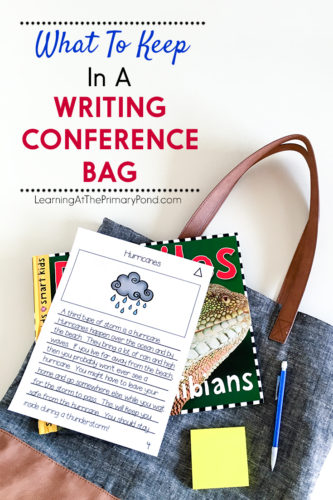
So I like to keep a conferring tote bag for my writing conferences. In the bag, I place:
- Gummy notes
- Writing utensils
- Anecdotal note forms and previous notes
- Mentor texts (published books, student samples, my ain samples, etc.)
- A notebook (if I'm working with second grade and up, so that I have more room to write than what fits on a sticky annotation)
How will I know what to teach during a conference?
Now that we've gone over the different parts of a conference, you might be wondering what you should teach during the actual conference! I will exist going more in-depth on this topic in a post two weeks from now. However, here are some tips to get yous started:
- Choose a Unmarried focus. Don't try to teach more than than one thing at a fourth dimension!
- Focus on your unit goals. Keep a checklist or rubric side by side to you that you can quickly scan if a pedagogy point doesn't come to you immediately.
- Retrieve that you lot can teach a strategy more than one time! Most kids (peculiarly our little ones) need lots of reinforcement. Y'all tin can have 2-iii conferences with one kid on the same strategy!
- Brand a plan beforehand for your conferences. You can determine what to teach by reading students' writing or by reviewing your own anecdotal notes from previous conferences. Sometimes, your plan may exist to merely observe and decide on a teaching point during the bodily conference.
When I'm conferring with a student and need to choose a instruction point, the easiest thing for me to practice is focus on writing conventions.
Missing periods, or misspelled words, or incorrect capitalization just jumps off the folio at me. I run across those mistakes immediately, and I don't really have to recall nearly what to teach.
However, as important every bit correct conventions are, many of our writing conferences should focus oncontent. We accept to exist able to intentionally ignore the misused question marks and think near the strength of the introduction, the absenteeism of a conclusion, the employ of transition words, inclusion of details, etc. These content-focused lessons are what tin can really move our students forrad in their writing.
How practice I get my kids to work independently so that I can stop putting out fires and actually have time to confer?
Gosh, this question lone could fill up so many blog posts! But in a nutshell….getting kids to "go out you alone" so you lot tin can confer comes down to establishing consistent routines and classroom management.
Whether you're establishing routines for the school year or reworking your workshop mid-year, begin possible bug that students may encounter. These can include things like…
- Getting stuck or not knowing what to write virtually
- Not knowing how to spell a word
- Needing a drink/bathroom interruption
- Running out of paper
- Needing a new pencil or eraser
- Ripping a piece of writing
- Being bothered by a peer
Plan a lesson virtually each trouble that you come up with. During the lesson, work with students to create an anchor chart that the kids can use to solve these issues (independently!) in the hereafter.
And when the trouble actually arises for a educatee, require the pupil to use the ballast chart to solve it! If you lot solve the problemfor the student (or even just suggest a solution), she'll learn to rely on you and continue interrupting your conferences.
Too, call up that it's okay to backtrack at any point during the year. Subtract the amount of time students write independently. Revisit those expectations. Stop conferring and coming together with small groups then that y'all tin can focus on classroom management. The time you spend establishing procedures will pay off immensely in the hereafter!
In add-on to establishing a strong management system, giving students supportive tools volition also help them piece of work more independently, thereby freeing yous up to confer. Differentiated writing paper (which I'll talk more than about in time to come posts) and supports similar an alphabet chart or checklist can make a big divergence in how much students can accomplish independently.
My free writing folder set includes tools like an alphabet chart, vowel chart, genre mini-anchor chart, checklists, and more than. If y'all don't already have information technology, get it HERE!
Conclusions
This was a long post, considering it's about an instructional practice that takes but v minutes! But I think that this just goes to show how circuitous writing conferences really are.
Conferring, whether it's during reading or writing, is something I'malways working on. Requite yourself some grace if your conference accidentally takes 10 minutes. Or if yous showtime with just one briefing per day.
Small steps in the right management can make a big difference for your students. Happy educational activity!
References
Ackerman, One thousand., & McDonough, J. (2016). Conferring with Young Writers. Portland, ME: Stenhouse Publishers.
Mermelstein, L. (2013). Self-Directed Writers. Portsmouth, NH: Heinemann.

Source: https://learningattheprimarypond.com/blog/conduct-writing-conferences-students-primary-grades/
0 Response to "what to do during a writing conference with elementary students"
Post a Comment