How Do You Know if You Gotta Go Back to Dr After C Section
How to Do a Damn Periodical Society
Brandon and Steph'due south Notation: As pharmacists, we demand to able to efficiently assess a periodical article for its usefulness. In your do life, prescribers will inquire your opinion on Ten therapy given the new data that was just published. Or you'll become a patient that REALLY wants to take scorpion venom to treat their cancer (and they have an article to show how great it works). Or you'll have someone that wants to know if the Pfizer COVID vaccine is safe for their pregnant wife (and if so, does the trimester affair?).
And, sure, y'all can temporarily go off the hook with the standard, "I'll expect into it and let you know" type of answer. Simply then y'all gotta actually be able to read those articles and codify a reasonable, educated opinion. As well, no pressure, just your answer will impact a patient's life .

We are going to try really hard not to spend likewise much fourth dimension here in this post. (Image)
Sometimes, as both a student and a real-life practicing pharmacist, y'all'll take to lead a journal club, which brings us to the topic of today'due south postal service.
At that place isn't necessarily a "correct" way to do a periodical guild, but at that place is definitely a "wrong" way. This article will teach you the ins and outs of conducting your own damn journal club (don't worry, we'll effort our all-time to stay off of our discourse). Let's dive in.
Journal Club Training: What to do Earlier Your Presentation
Before starting, take a moment to consider WHY you're doing a journal club in the first identify.
Nosotros'll give y'all a hint — the answer isn't, "Because my preceptor told me to," or "To satisfy a requirement for my P4 portfolio."
At that place are several reasons to practice a journal club. Broadly speaking, they apply whether you are a pupil, resident, or a seasoned practitioner:
-
To develop your ability to sift through minefields of clinical information and formulate an evidence-based plan for your patients
-
To amend your power to communicate that information to others
When y'all do it correct, anybody in your audience benefits from your periodical guild. Get a grouping of clinicians together to discuss an article, and they all go out the give-and-take as slightly better clinicians. By sharing cognition and insight, your efforts tin can compound to the whole grouping. And, through thoughtful word, you're all better equipped to tackle the difficult drug-related questions that come at you lot from prescribers and patients.
Second, put some thought into WHAT topic to present.
Depending on if you are a student or not (and depending on the preferences of your preceptor), you often volition get some say in deciding which journal commodity to present. So…what practice y'all choose? Plainly, your starting criteria should be the topic of your rotation. If yous're on an infectious disease rotation, it'south probably best not to suggest an commodity about the latest findings in center failure.
We encourage you to find a topic that you're genuinely interested in learning more virtually. Don't just selection blindly from the latest NEJM. Yep, nosotros know information technology'due south "high quality" and has the article sections nicely organized to lucifer your presentation template. That'due south a perk, for certain. Simply to do a journal club right, you need to acquire more about the underlying affliction state (more than on this in a fleck). You may every bit well brand information technology fun and beneficial for yourself by picking something that piques your involvement or even something that you know is a weak spot for you.
Unless your preceptor tells you otherwise, experience free to peruse different journals, even those that accept lower touch factor scores (gasp!). Believe it or not, you can larn a lot from a BAD journal article — in fact, 1 might fence you can learn More than from a bad article than a cracking 1. The play tricks is to recognize the things that brand the report lower quality.

Hone this. Y'all need it. (Image)
Merely to be articulate, nosotros're not saying that you lot should always choose articles of poor quality. It's but that, in the future, you lot may be managing patient populations that don't brand the front page of NEJM. Or you lot might specialize in an area (east.thou., oncology) where drugs tin get an accelerated approval based on their Phase 2 results. You won't always take data from the gold standard Phase 3 Randomized Controlled Trial. You'll practice yourself a favor by getting comfy evaluating less-than-ideal publications (the better to strop your BS Detector!).
Third, consider WHO your audience is.
Really, this is a good rule for every presentation. Put yourself in the shoes of your audition. What do they need to know? Why is this important to them? The data that a pharmacist finds relevant is very dissimilar than that of a Nurse Practitioner. Brand sure that you're presenting data that your audience volition find useful.
For example, let's say y'all are a student taking Brandon'southward APPE rotation (you lucky duck, y'all). And let's say you're presenting a journal club to the pharmacy squad virtually a new drug that was only approved for some type of cancer. What does the pharmacy team need to know? Well, for starters, we need to know the obvious stuff like side effects and drug interactions. Only we also demand to know where this new drug fits into the electric current treatment prototype. Is it simply to be used equally the third line of therapy (or subsequently)? Is it only for patients with metastatic affliction? Where does the new drug fit (and how much does information technology price) compared to electric current handling options? These are the blazon of questions that the pharmacy team will exist fielding from patients and prescribers, and so this is the information that y'all'll want to present.
4th, include handouts.
This is a relatively simple one, just even if you are using PowerPoint to present your journal social club, be sure to include handouts. At a minimum, your handout NEEDS to include the paper you are presenting. Yes, you lot should have already emailed the paper to your audience (at least a few days in advance, only ideally a calendar week). Simply most folks in your audience will not retrieve to bring this to your presentation, and if they don't have laptops to pull up the article in the moment, information technology could brand it more difficult to have a robust word. It REALLY helps to facilitate give-and-take when everyone tin expect at the paper together. Your handout can likewise include your summary — which brings us to our next section.
Should You lot Use a Journal Club Template?
Many schools (or even specific rotations) will provide you with a journal club template. You can find a bunch right here if yous don't have ane. Journal lodge templates can make for nice handouts during your presentation. They can help guide your thinking when you are reviewing the article, and they are a adept place to drib important reference points.
And then, yep, use a journal society template if that'south your thing. Go basics.

How it feels when you're in the journal club audition and you realize the presenter is just going to read directly from their handout. (Paradigm)
But (yous knew this was coming, didn't y'all?)…
Delight, for the love of all that is holy, don't treat the template like a scavenger hunt.
There is a tendency, especially when rotation gets crazy and you're pressed for time, to plug the information into each box and so read it aloud like you're checking off boxes.
"Here's the inclusion criteria. The exclusion. The primary endpoint p-value…"
Obviously, that information needs to go there. Information technology serves as a quick summary and tin can exist useful for your audience to reference. Just information technology'southward almost also easy to transcribe data on your template and move on to the side by side thing. Yous'll pat yourself on the back because this section is "washed." The problem is, you oasis't actually EVALUATED a damn matter.
Yous have to think critically virtually the information you're plugging into your template. This critical thinking and assay leads to the bulk of the discussion of your journal guild. For every section of your presentation template, consider the following:
-
Practice y'all understand why a particular methodology was selected? What are the advantages and disadvantages?
-
Practice yous agree, or would you lot accept designed/presented the information differently?
-
What is clinically pregnant versus statistically meaning?
-
How tin this data be applied to your patient or patient population?
-
How does this therapy fit with other available management strategies?
-
What boosted information would you similar to accept to brand a decision about X therapy?
Ultimately, whether you lot use a template or non, there are a couple of questions y'all're seeking to respond with a journal gild:
-
If y'all had to echo this study, what would y'all have done differently? This is a dandy question to "reverse engineer" your encephalon into thinking critically about the information in the journal. When you call back nigh blowing the study up and starting from scratch, it'south sometimes easier to find holes in the methodology.
-
How will you adopt this new data into your exercise? Will yous use this new drug to treat your patients? If and so, which ones (and under what circumstances)? Remember, the end goal of a journal club is to help you brand informed decisions most patient care. Make sure you can answer this question.
What Makes a Good Journal Club?
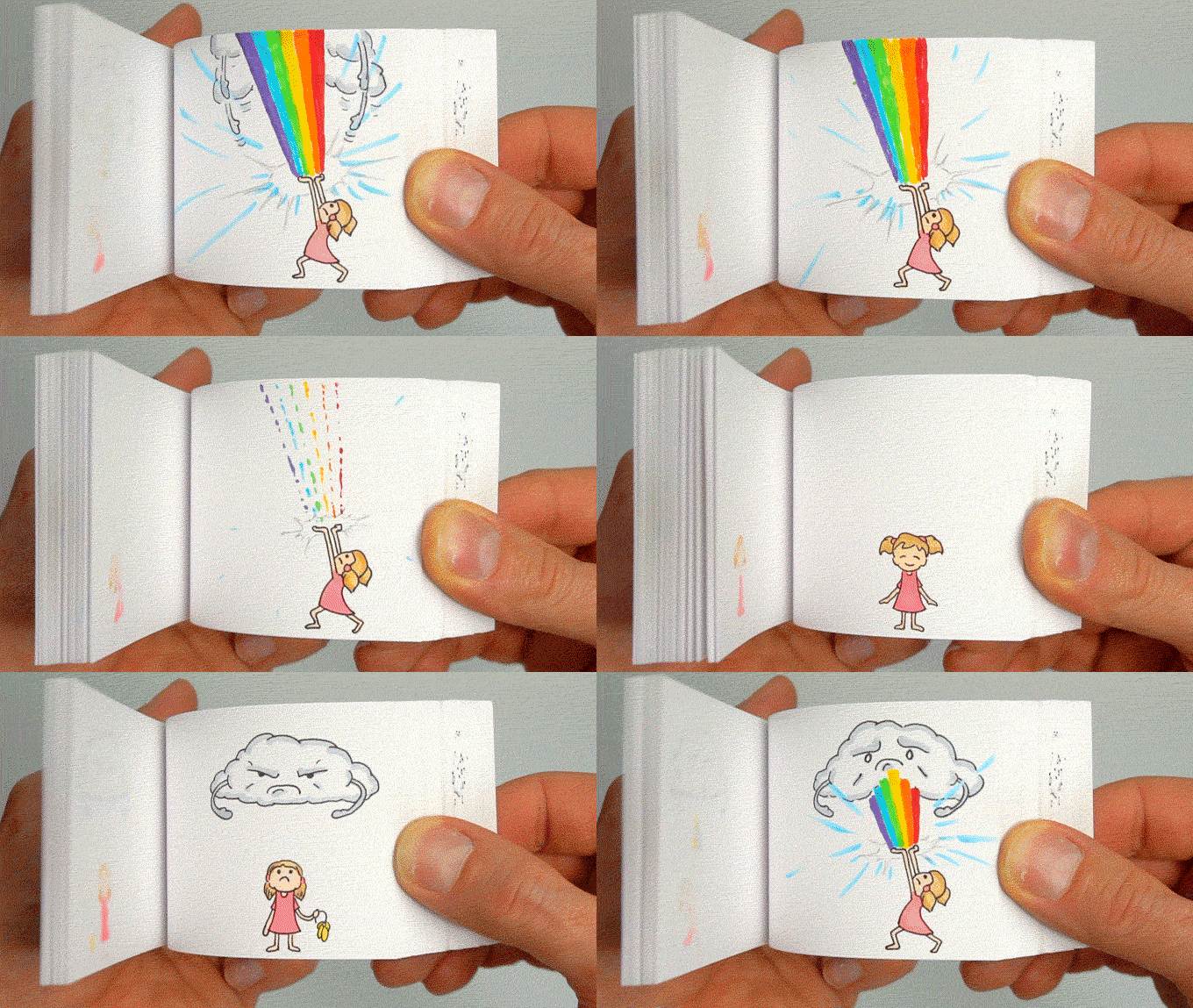
Aye, that'due south right. This is exactly what a body of literature looks likes. Prototype
Allow's start with a dark truth — A journal commodity (by itself) isn't all that useful to a clinician. This makes sense when you recall about it.
The exercise of medicine is shaped past the sum total of all clinical studies that accept ever been recorded. Taking out one study and analyzing it is like removing one picture from one of those flipbook animation thingys. You really need the total packet to see the entire picture.
By carefully selecting your patient population and your comparator arms, you can make an isolated clinical trial look really skilful (more on this in a scrap…). You lot can reach your primary intervention with p-values and confidence intervals that are borderline magical.
Just…that's just 1 written report. And without a larger trunk of bear witness to back up information technology, it doesn't assist us all that much when we're treating actual patients.
So, what should you lot do?
But put, when leading a journal club, it is YOUR job to put the commodity in its proper context. That ways you need to know the background and do guidelines for the therapeutic area. That means you demand to know what typical patients with the disease state look like. That means yous need to know what other treatment options are bachelor. In curt, yous need to do a shit-ton of homework.
Does this make journal gild a lot harder? Admittedly. But volition it teach you more, and exist more than useful to your audition? Yous betcha.
Another useful tip is to brand information technology a discussion rather than a presentation. Even though you are leading the journal club, the "club" indicates that there should be some back and forth betwixt multiple members. It's OK to enquire questions! It's commonly best if you "present" the background and study pattern first, so in the results (and specially the discussion section) you can open the conversation up a bit. You'll observe the discussion will take some interesting turns (and y'all'll probable learn a lot) in the process.
We mentioned this above, but information technology'due south worth repeating. The crucial questions you demand to reply in order to have a adept periodical society are:
-
How (if at all) volition you lot adopt this study into your pharmacy do?
-
If yous had to echo this written report, what would you accept washed differently?
Periodical Club Tips
If you're anything like united states, you might at present find yourself thinking, "Yeah, yeah, just what do I actually TALK ABOUT during my journal club?"
And hey, nosotros wouldn't be doing our tl;dr jobs if we didn't give yous guidance here.
In terms of what to talk nigh, think that most of the available journal club templates we mentioned will inherently provide some semblance of a structure to follow. If you're non using a template (or y'all merely Really want to avoid "reading" your template), a expert rule framework you can follow for your journal club presentation is: Who, What, Where, When, Why.
-
Who published the commodity? Who are the patients in the trial?
-
What was the intervention?
-
Where did the study take place?
-
When/how long were the intervention and follow-up periods?
-
Why was this report done?
This list is deceptively simple. But being able to answer these questions (specially the "why" office) will put you on your way to journal club success. Attempt to put yourself in the shoes of your audition. What exercise they need to know? What is most important to them? A group of clinicians, for case, will likely pay special attention to the inclusion and exclusion criteria of the written report. They need to know what the average patient in the study looked like since they'll ultimately exist deciding whether or not to give the therapy to an actual patient one twenty-four hours.
Spotting the "Hacks" in Clinical Studies
Who, what, where, when, why is a neat starting point for your presentation, but it won't give y'all all the ammunition you demand for a fruitful discussion. To get that, you need to talk well-nigh the strengths and limitations of the study. These are the extra things that add together weight to (or decrease weight from) the conclusion the authors reached.
While this is by no means an exhaustive list, here are some common "hacks" you may run into. They are tricks that authors tin use to make a study look a lot better than it really is.
The Role of Funding in a Clinical Trial
Almost every report yous read will be funded by a drug visitor. Is that a source of bias? Of grade. But recall almost it — Who else is going to pay for an expensive clinical trial? Who else has a vested financial interest in the drug?
And then…yes, you lot tin can listing it as a limitation…but it doesn't completely invalidate the study. It but means that you need to read with an eagle heart and your BS radar tuned up.
Plus, there are different levels of drug company sponsorship. Simply because Pharma sponsors a written report doesn't mean they have a hand in every single aspect of the publication. Sometimes they but provide the drug and basic funding. Sometimes they're involved in study pattern. Sometimes they're doing information drove, analysis, and interpretation. Sometimes they hire a medical writer to write the manuscript.

This is basically the Abstract of a Clinical Study
Hither's a good dominion of thumb. The less involved the drug company is, the ameliorate. And the more transparent they are about their level of involvement, the better.
In our (anecdotal) experience, it'due south becoming increasingly mutual to see Pharma human activity like a "helicopter parent" and micromanage every aspect of the publication. That isn't necessarily a bad affair, as long as they're upfront and transparent about it.
But on that notation, go on this in mind…
The study you're reading is basically a sales brochure for the drug company (even if it'due south published in a high-impact periodical like NEJM).
Nosotros've written before about the dangers of but reading a study's abstract. We've argued that the abstract is like a magazine cover for the drug visitor — nothing more than a sexy headline to convey their bulletin.
But it actually extends deeper…
The unabridged paper is a sales brochure (especially when the drug company is involved in every step of the data collection, assay, interpretation, and presentation). Think about it.
The drug company gets to choice WHICH graphs they bear witness you. Merely because yous're looking at a super-separated Kaplan-Meier curve doesn't mean the endpoint is relevant.
And pay attention to the axes. Did they scale the y-axis differently just to make those curves separate more dramatically?
Our goal here isn't to make you lot a nihilist or to say that everything you read is a lie.
Nosotros're merely maxim it's better to approach a study thinking, "The benefit of this affair is probably overstated, and the risk is probably understated. Let the data show me wrong!"
To summarize, drug companies volition fund almost every clinical trial you read. Understand the inherent risk of bias that this presents, read the study with an advisable grain of common salt, and proceed with your assessment.
Permit's signal out some other means to brand a study look better than it really is.
Cherry-Picking the Report Population
I manner to mask the frequency of side effects of a drug is to over-correspond younger and healthier people in the study population. This is especially common in oncology trials, where younger patients tin can improve handle the toxic treatments (and they tend to live longer to boot!). In gild to extrapolate the results of a study to existent patients, the patients in the study have to exist similar.
Will the results of a study done in mostly 45-yr-old Caucasian males employ to a 78-yr-erstwhile Vietnamese female person? Are y'all telling me that NONE of the patients in this American cardiovascular illness study are obese? Or accept diabetes? This drug just got approved for 5th-line multiple myeloma…how is it that the treatment population in the study all had an ECOG functioning status of 0-1?
These are the types of hard questions y'all should ask yourself during a journal lodge. It's a crucial style to determine whether or not the results will apply to patients in the real world.
Cherry-Picking the Endpoints
Do you desire to know one of the easiest means to dispense the information to make a drug expect fantastic? Move the "goalposts" of what yous're measuring. Clinical trial endpoints are and then important that we defended an entire postal service to them. Read that to become an in-depth guide.
Have a close look at both the primary and secondary endpoints of the study. Are they relevant to the disease country? Did the authors create a composite endpoint or employ a surrogate endpoint? If they did, was that appropriate? Is the chosen noninferiority margin clinically significant? Is there an endpoint that would have made sense to study for the disease country or treatment, and it'due south non in that location? Why??
Cherry-Picking the Control Group
This is directly out of the "Used Automobile Salesman's Playbook." If y'all do a report comparing your new drug to an ineffective (or overly toxic) therapy, your new drug will look amazing. Simply is that reflective of how patients are treated in the real world?
Expect, we know glatiramer isn't all that constructive for multiple sclerosis. And so please don't try to sell us the "dramatically improved disability progression numbers" with your new, fancy disease-modifying therapy when nosotros wouldn't take used glatiramer in that patient population in the start place. Capisce?
Displaying Impressive Graphs that Don't Really Affair

Don't be fooled by the pretty colors. Make sure the charts you're reviewing really SAY something. (Paradigm)
Nosotros hinted at this 1 above, but information technology'due south worth mentioning once again. Don't be swayed by the glossy, pretty pictures in a written report without first stopping to smell the roses. Does the endpoint depicted in the graph actually thing? Are the axes evenly distributed to avoid exaggerated results?
We won't telephone call out anyone specifically, only nosotros've recently seen a publication on prostate cancer that displayed a very prominent Kaplan-Meier curve depicting the difference in "Pain-Gratis Progression" betwixt the command and treatment groups. To the best of our knowledge (and do experience), that is a 100% made-up endpoint. Information technology was a fantastic-looking graph, tho.
Using Percentage Changes for Pocket-size Sample Sizes (and Vice-Versa)
Whoa, this intervention reduced the primary endpoint by over 30%! Oh, BTW, it was just in 40 people…
I mean, c'mon, is that actually generalizable to an entire patient population?
Stealing another page from the "Used Motorcar Salesman's Playbook," positive results can exist presented as percentages (rather than absolute numbers) to make the outcome seem bigger. A "xxx% reduction in the outcome" is a sexier finding than "The outcome occurred in 7/ten people."
You'll meet the reverse every bit well. A negative side effect will be presented as a number (rather than a percentage) to make it seem smaller. It'south a lot easier to report that 8 people compared to four people experienced a major drain. Otherwise, yous'd accept to say that there was a 100% increase in major bleeds.
Another mode this trick presents itself is when the authors present the median even in cases where the mean would exist more appropriate.
This game of basic number manipulation isn't necessarily faux…it's just sneaky. It'due south a mode of exploiting our human nature. Information technology's the same thing the car dealership does when they listing that vehicle with a auction price of $24,999. Your lizard brain tells you you lot're getting a steal for less than $25K - when in reality, we're talking a dollar difference.
Using Relative Risk Instead of Accented Adventure
This is a different, only like, shade of the example above. If Treatment A carries a risk of 15% and the new, fancy Treatment B carries a risk of 10%, the relative risk reduction is 33% for Treatment B. Yeehaw! That'due south pretty impressive, yay? A tertiary less!
But allow's be real hither. It's really just a 5% reduction in absolute take a chance. Is a risk of 10% for Handling B really what we're after? And is that modify from Handling A worth the potential increased cost or toxicity?
FYI, most clinical studies (and especially the media) report relative take chances reductions (and increases) instead of absolute hazard. They do this because it'southward more than attention-grabbing. Unfortunately, you will take to go through the article and calculate absolute hazard by manus. Just and so can you lot determine if the difference is clinically relevant.
Using "Marketing" Terms Instead of "Statistical" Terms
There's aught more annoying than reading that a event "approaches significance." This fabricated up term is a load of marketing balderdash hockey. The signal of a p-value is to delineate statistical significance or not. In that location is no in-between. And then delight don't accept that a p-value of 0.054 is "budgeted significance" if the threshold is set at < 0.05.
Other mutual marketing terms include descriptions of "substantial" or "profound" effects. If you lot see these terms, remind yourself that they are another way of saying, "Nosotros didn't get the outcome nosotros were hoping for…but we actually felt like we should accept!"
Or, put it this manner…
If the outcome was powerful plenty to attain statistical significance, the authors would take used statistical terms…wouldn't they? If you run across a bunch of pinnacle adjectives flying around, your BS Detector should go off.
Powering for Non-Inferiority, Then Doing a Superiority Analysis
You technically tin design a non-inferiority trial and and so analyze it equally a superiority trial. But at that place are pretty strict dos and don'ts when doing this (read a nice review article hither). And either fashion, the practice is more often than not (at least in the circles I walk in) not welcomed with open artillery. The FDA also has some guidance on it, and they're definitely not in love with the practice.
Information technology's looked at as a form of data dredging (encounter the side by side tip). You're changing the analysis of your data after the fact in a manner that your trial wasn't designed for. And you're doing information technology in a way that clearly benefits you financially.
When you're reading the latest sexy report, watch out for this fob. Information technology's more than common than you think. Honestly, that'southward pretty surprising given the FDA guidance on the discipline.
Data Dredging

Aw, nosotros can be happy that this squirrel found a nut (or 2)! Merely we shouldn't exist quite and so elated when it seems similar study authors magically find nuts… (Epitome)
You know the saying, "Even a blind squirrel finds a nut every in one case in a while?" This is an apt description of data dredging. Basically, if yous analyze the data from enough angles, yous're probably going to find something significant. But, if yous've read our article on the p-value, you know how fickle it is. Does massaging the data until you have a statistically meaning result make it clinically significant?
Broadly speaking, if y'all run across endpoints that are "postal service-hoc," that means they were added on AFTER the fact. This is a huge scarlet flag for data dredging. It's always best to determine your endpoints up front.
Some other full general rule -- The more secondary endpoints there are, the more probable there was dredging. Obviously, this isn't E'er true, just something to be aware of.
Always be on the lookout for the term "Exploratory Analysis" considering that literally means p-hacking. A neat trick you tin do is to wait the trial up on clinicaltrials.gov and run into what they were supposed to exist studying. If the endpoints they publish in the newspaper aren't what'due south listed on that site, you can pretty much assume they went fishing for significant data.
Overly Complicated Statistics/Trial Design
Think back to your high school chemistry class. The whole indicate behind the scientific method is to come up up with reliable, reproducible results. When a report's pattern is overly complicated, whether due to handling groups, schemes, or statistical analyses, it makes it that much more difficult to replicate the results. It also makes it more than difficult for the peer review customs to phone call foul.

If y'all reach Crazy Charlie level trying to fix your journal gild, the report design is probably too complicated. (Image)
Ever evaluate whether or not at that place was a better way to answer the question at mitt. Or, if the trial protocol is realistic in the existent world. Would you have designed the study differently? Used different patients or endpoints to make this more than applicable to the population in question?
Using Ane-Tailed Instead of 2-Tailed Analyses
We can already see your eyes starting to glaze over, so let's first by checking out this commodity. They practice a corking chore at spelling out the differences betwixt 1 and two-tailed tests.
A two-tailed examination assumes that your intervention could have an impact in either direction. Pregnant, the new drug y'all are testing could improve the disease...or information technology could brand it worse. Sure, yous may SUSPECT that the drug is going to help your patients -- that's why you're giving information technology to them. But really, y'all have no manner of knowing if the drug will do more benefit than harm. The two-tailed analysis allows you to exam both directions of your intervention.
A one-tailed test, past contrast, assumes that there is simply one possible direction of do good. Your intervention couldn't possibly be worse than the control group...it MUST be better than (or equal to).
Here's the big takeaway. Information technology is much easier to achieve statistical significance with a one-tailed test...but it is almost ALWAYS advisable to conduct a two-tailed analysis. At that place are very few instances when a one-tailed test is OK.
If you encounter a one-tailed test when yous're working on a journal club, look at it with a VERY scrupulous fix of eyes. It'due south nearly likely inappropriate.
tl;dr's Journal Gild Summary
Basically, nosotros're asking you to remember critically. For the dear of Pete, if you're going to apply a template, use information technology as a guide rather than a script. Hone your BS-ometer. Encourage discussion in your group session, and make it an environment where it'due south safety to share thoughts, even if others disagree or they're incorrect.
There are more gray areas in pharmacy and medicine than y'all would ever approximate. Chemist's shop school will throw treatment guidelines at you lot for every disease land y'all can think of, and yous have to know how to navigate them.
Merely if y'all really want to be a successful chemist, you have to learn how to evaluate and discuss the evidence. The more articles you read (and the more periodical clubs you lot participate in), the amend you lot volition become.
Lastly, take fun with your periodical clubs! (Really! They should exist!)
Further Reading
Nosotros've given a high-level summary hither, only if you want to learn more about journal clubs, biostats, and literature evaluation, check out these other posts on our site. They'll cover a lot of ground that we weren't able to get to in this post.
-
How to Be Awesome at Biostatistics and Literature Evaluation Part I, Part Ii, Part Iii, Part IV
-
Everything You Know About the P-Value is Wrong
-
Absolute Risk Reduction
-
Clinical Trials That May Change What You lot Were Taught in Pharmacy School Function I, Part II
-
The Use of Aspirin for Master Prevention
-
The tl;dr Journal Order - The COMPASS Trial
-
The tl;dr Periodical Guild - The HOPE Trial
-
The tl;dr Journal Social club - Insulin Icodec
Source: https://www.tldrpharmacy.com/content/how-to-do-a-damn-journal-club
0 Response to "How Do You Know if You Gotta Go Back to Dr After C Section"
Post a Comment